Tuesday, August 30, 2016


Tuesday, August 30, 2016 First day of Earth Science: blog quiz corrections/ thought out answers

  1. We see because light brightens things.
    1. true: however the process of sight is far more complicated than that. 
    2. false what we are actually seeing is the reflection of the light. 
  2. The Moon goes around the earth in a single day.
    1. false it takes almost a month for the moon to get around the earth. 28 days to be exact
  3. The amount of daylight increases each day of summer.
    1. the amount time we have daylight does increase until we hit the summer solstice in which the days start to get shorter again. 
    2. half of the earth is always lit up
  4. People cannot see planets with the naked eye.
    1. this is false: for example we can see Mars from earth, and other planets we need assistance 
  5. People can see the Great Wall of China with the naked eye from space.
    1. I have heard that this is a true fact. I think this would be a very exciting event if you were out there to look down at our home. 
    2. false according to the astronauts you cannot
  6. Astrology (the position of the planets and constellations) gives us insight to people mannerisms.
    1. this is false, but sometimes due to a psychological thought that these positions effect your personality it may give an insight into peoples mannerisms because of a self-fulfilling prophecy
  7. The Sun will never burn out.
    1. this is false, the sun is a star and eventually all stars die, however it may be a very long time in the future. 
  8. The Universe is a static.
    1. I  do not know what this means
    2. static means it does not move- so this is false  because the universe does move
  9. If a crystal can scratch glass it is a definitely a diamond.
    1. this is false. there are multiple rocks and minerals out there that you can test what type of mineral they are by whether or not they can scratch glass. it means its harder than glass
  10. Diamonds are expensive because the extreme rarity of them.
    1. diamonds are not extremely rare, in fact they are rather popular, however retailers have placed a high value on them. 
  11. Soil must have always been in its present form.
    1. soil has changed over time, you can see this based on the levels that are present from varying time periods on earth. 
                                                                   
  1. Earth’s gravitational attraction is drastically reduced on mountain tops.
    1.  false. this depends on he level the mountain tops are at. 
  2. Continents are constant and do not move.
    1. the land may shift depending on tectonic plates, but overall they stay within the same region.
  3. The Earth is between 6-20 thousand years old.
    1. this is a highly debated topic, and I am unsure the exact date of planet earth the earth is about 5,000 years old
  4. Dinosaurs and cavemen lived at the same time.
    1. false
  5. Rain comes from clouds sweating.
    1. I would not call it "sweating" but yes, the clouds collect a certain amount of moisture in the atmosphere until they get to heavy relative humidity
  6. Frontal rain is caused by "cooling by contact" between fronts.
    1. I do not know weather patterns. air masses do not mix, they run into one another- one would go up- the other would go down. 
  7. All rivers flow "down" from north to south
    1. false rivers flow from high elevation to low elevation
  8. Ground water typically occurs from basin, lakes, and fast-flowing streams.
    1. true. no groundwater is sort of a sponge like action- not just a pit of water. 
  9. Salt added to water does not change the weight of the water.
    1. no the H2O does not change,  but it would change how much it weighs on a scale.


Tuesday, August 23, 2016

First day of Earth Science: blog quiz


  1. We see because light brightens things.
    1. true: however the process of sight is far more complicated than that. 
  2. The Moon goes around the earth in a single day.
    1. false it takes almost a month for the moon to get around the earth. 
  3. The amount of daylight increases each day of summer.
    1. the amount time we have daylight does increase until we hit the summer solstice in which the days start to get shorter again. 
  4. People cannot see planets with the naked eye.
    1. this is false: for example we can see Mars from earth, and other planets we need assistance 
  5. People can see the Great Wall of China with the naked eye from space.
    1. I have heard that this is a true fact. I think this would be a very exciting event if you were out there to look down at our home. 
  6. Astrology (the position of the planets and constellations) gives us insight to people mannerisms.
    1. this is false, but sometimes due to a psychological thought that these positions effect your personality it may give an insight into peoples mannerisms because of a self-fulfilling prophecy
  7. The Sun will never burn out.
    1. this is false, the sun is a star and eventually all stars die, however it may be a very long time in the future. 
  8. The Universe is a static.
    1. I  do not know what this means
  9. If a crystal can scratch glass it is a definitely a diamond.
    1. this is false. there are multiple rocks and minerals out there that you can test what type of mineral they are by whether or not they can scratch glass. 
  10. Diamonds are expensive because the extreme rarity of them.
    1. diamonds are not extremely rare, in fact they are rather popular, however retailers have placed a high value on them. 
  11. Soil must have always been in its present form.
    1. soil has changed over time, you can see this based on the levels that are present from varying time periods on earth. 
                                                                   
  1. Earth’s gravitational attraction is drastically reduced on mountain tops.
    1.  false. this depends on he level the mountain tops are at. 
  2. Continents are constant and do not move.
    1. the land may shift depending on tectonic plates, but overall they stay within the same region.
  3. The Earth is between 6-20 thousand years old.
    1. this is a highly debated topic, and I am unsure the exact date of planet earth
  4. Dinosaurs and cavemen lived at the same time.
    1. false
  5. Rain comes from clouds sweating.
    1. I would not call it "sweating" but yes, the clouds collect a certain amount of moisture in the atmosphere until they get to heavy
  6. Frontal rain is caused by "cooling by contact" between fronts.
    1. I do not know weather patterns. 
  7. All rivers flow "down" from north to south
    1. false
  8. Ground water typically occurs from basin, lakes, and fast-flowing streams.
    1. true
  9. Salt added to water does not change the weight of the water.
    1. no the H2O does not change,  but it would change how much it weighs on a scale.


Tuesday, December 9, 2014

co-evolution

It was my birthday, and I got to pretend. It was a lot of fun. It was difficult however, because I had to be a knife beaked bird. This activity demonstrated natural selection because we had three different types of bird beaks fighting for different types of food. We had knives, forks, and spoons. Hearing that I was a knife I knew how hard I would have to fight to survive.
This activity demonstrated natural selection because over generations the number of my fellow knives diminished while the other populations flourished. Another natural selection occurred with the food available. The split peas grew large numbers, while the pasta shrunk.  This brought up the fact that the more easily it can be attained the easier it may be wiped out. This made me think of protection factors. The split peas protection was the difficulty of attainability.
This activity demonstrated co-evolution because as one type of beak went up, so did a type of food. the prefered food seemed to have been the noodles, because they were the easiest to obtain. The split peas were the item that got to expand as not many of them were being eaten. spoons were the most successful because they were able to pick up the most food. My food was difficult to obtain because all I could do was was fling my food in the air and try to catch it when I was left by myself.
When I was able to work with others we worked together one person pushing the food onto the others "beak". I felt it was easier to work alone, as I was able to obtain more food that way. If we had had more time to talk before the food scramble we could have made a better strategy for working together. This could be similar to an occurrence in nature. some creatures find working together to be the answer, others working alone. This also goes along with natural selection.
Overall I enjoyed this activity. I have done similar activities before in my science courses. I was reminded especially of my 7th grade science class. We instead had to pick from a variety of tools or utensils as our beak, and then went through a bunch of stations. We saw that some situations our beaks were evolved to fit, in others, not so much. to return to the point, this was an interesting activity that provided a hands on representation of the study at hand. I really enjoyed it.

my bottle habitat

what do I call this little picture of life? My bottle habitat was something I was very excited about. One problem was I never got it to fully stay sealed. I guess I would name my bottle habitat the broken garden. It offers a bit of peace, a reminder of the green warmer times, but it has its broken zones.
I loved how it can survive over this three month period without any maintenance.

My habitat is a base pond with some vine like structures in the upper bottle with a moss side zone.
I am surprised that with the little amount of sunlight my bottle received that it was still able to have a proper photosynthesis cycle. My plants don't seem to have grown any bigger, all they have done is survive.
I don't understand how it can survive all I know is that it has. I love plants, and I cant wait to try this with my students someday. Plants have always been an interest for me. plant life reminds me of grandmas house, she has 4 huge gardens within her yard, as well as her own greenhouse attached to the back of the house. My bottle habitat is essentially a mini-version of this greenhouse. All I can say is I love plants!

new outdoor adventure!

My winter adventure. It was crazy, all this snow in one night! It started as a risky ride trying to get back to my apartment. I finally made it after a 10 minute drive turned into 50 minute drive. I thought to myself there is absolutely no way that I am going out  int hat again. And then, the next day we had a snow day. Downstate my family was enjoying the lovely fall weather meanwhile I'm freezing and trying to figure out how to survive this snow-in with only a small stock of food. So I was stuck, nothing to do on the inside, so I decided to take advantage of this winter wonderland and went to play outside.
My dad built me snowshoes, I had never tried snowshoeing before. walking out the door was like getting blasted in the face with a polar vortex. I guess thats what the weathermen would call it anyway. My first attempts at walking above the snow were very wobbly and unstable. It felt like I was learning to walk again for the first time. there is a certain art to snowshoes. There is a lovely little hill right behind my apartment that I decided to tackle.

The weather was scary to say the least. I felt like an arctic explorer all bundled up in about ten layers of clothes. I gave up on the snowshoes after I tumbled down filling my face with a  wonderful bunch of snow. So instead I built a snowman. Being outside in the snow is so wonderful. I love winter. I hate driving in it, but I love exploring using my own two legs and eyes. If it hadn't been so difficult to get out I would have gone even farther. I will never forget this wonderful double snowday.

Wednesday, October 15, 2014

Chernoff Faces

This activity was a strange one for me. I liked the way we could visualize by physically categorizing ourselves, but still no two were alike. I suppose I learned that in terms of classification, there is no perfect way to classify something, as each individual is different. Scientists pick what is most important feature similar to what we did in class, but this can change in an instant. My face stayed exactly the same both times, but my group changed dramatically. Even though it was still based on face shape, what we saw as most important was entirely different. Majors as compared to where we were from. its like comparing the food animals eat vs what kind of home they live in. You will find many similarities between items. and creatures, but also many difference.  How much does classification really matter?  How do we decide what is most important. Overall this activity just raised more questions for me than answers. I did like the interactions of the activity. Questions are something I will always have, and now I have more to look into.

Presque Isle Community

walking around presque isle, you will find all kinds of life. things you don't usually think about, but its all there, surrounding you. Nature is amazing, and just a few miles from home you can find this amazing habitat. This blog is going to be a sort of virtual walk through presque isle, with a few wordy stops along the way.

Upon a walk through the woods, whilst identifying trees my group and I came across a lovely doe and her fawn. This doe was surprisingly comfortable with all four of us in close proximity to her, but living in a place such as Presque Isle I suppose she has become sensitized to human presence
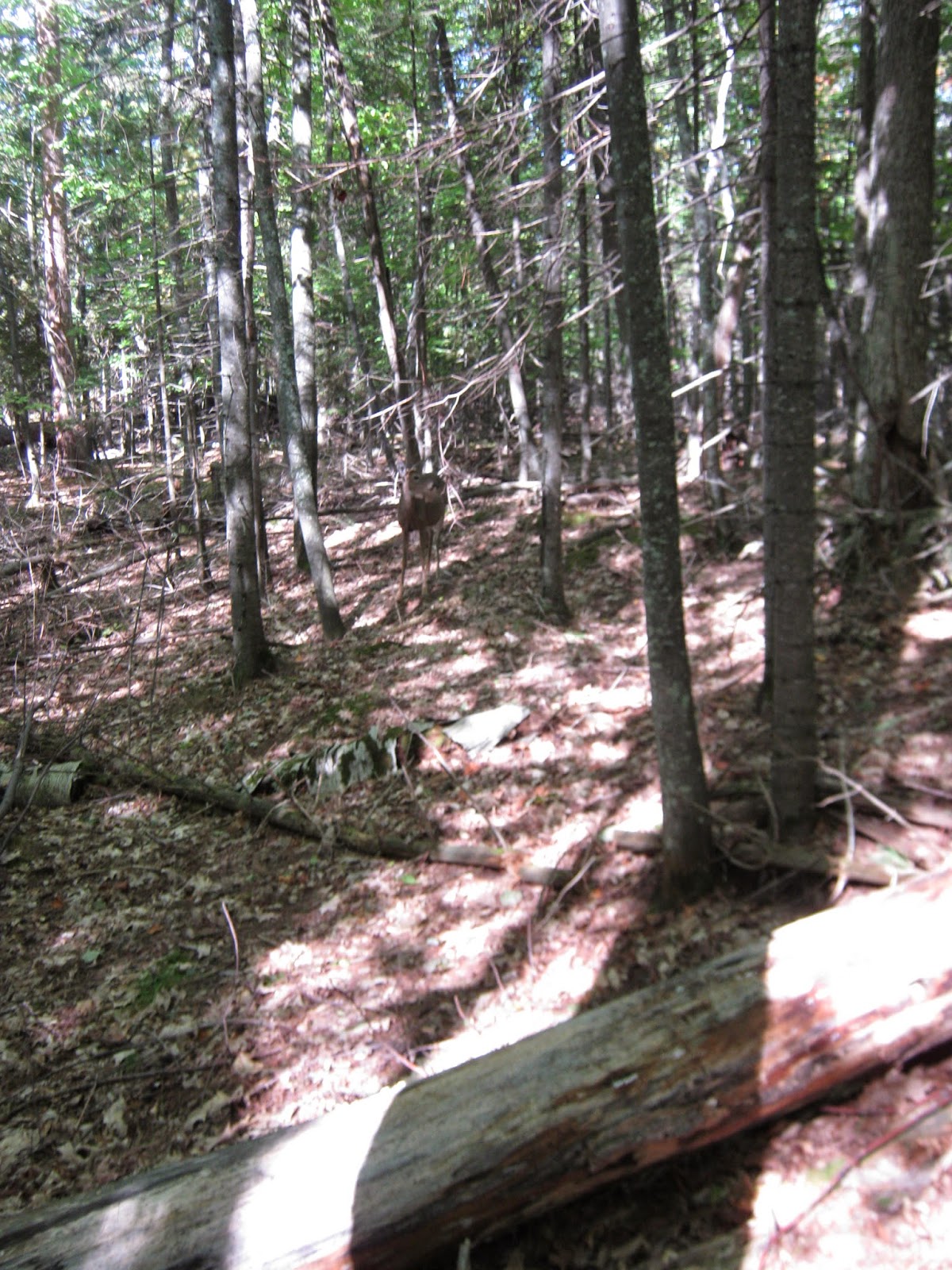
I got within ten feet of this beautiful creature. Her fawn stayed further back. 

A deer provides an excellent example of inter-specific competition. This deer, is more commonly seen than its competitor the moose. The moose and deer both share this habitat and require similar resources. Shelter, food, and water. Water is not scarce anywhere on this island as it is surrounded by the beautiful lake superior, this resource maybe also become a challenge when the lake gets frozen over. Plant life, on the other hand can also get scarce during the winter months. even though the forest is filled with life, and packed with trees, the resources still are fought over, thus the competition.  
(I wish this photo was mine, I've never seen a moose in real life, not even from a distance) photocredit wiki commons

Another thing that the deer can provide us with is an example of parasitism. The deer itself is obviously not a parasite as a deer is an herbivore. No, its not the deer, but its passengers, ticks and fleas. These little buggers, that we try so hard to prevent on us and on our canine friends, can be found all over a hunters favorite animal. Ive even heard stories of massive swarms of these little blood suckers, adding mosquitoes into the bunch, taking down a full size moose. Of course, in this cold northern climate, the winter is a sort of break away from these nasty things, as they cannot survive in the cold.
To continue the journey around presque isle we now look for commensalism. Commensalism is a difficult thing to find, as generally when two items interact both are impacted, but in commensalism, one item benefits and the other is neither harmed nor benefited. I found an example of commensalsim within an old tree stump. A chipmunk or some other small animal had made their home there. The stump was not being harmed or helped, but the chipmunk had a great place to make a shelter. 
notice the small hole at the  base.

The next item that would be commonly found in presque isle is mutualism. Both organisms involved benefit. The relationship I choose I did not see this fall, but saw plenty this summer.  Bees play an essential role in polonating all the flowers that grow in this beautiful park. th bee benfits for their hive, and the flowers get to reproduce. They both benefit from their interactions. Close by on the  bog walk, that our class went on earlier this semester I saw plenty of this interaction. There are whole fields full of beautiful flowers thanks to this mutual interaction
Next on our tour, lets look at intraspecific competition. For this I turn to the trees. Presque isle is full of trees. They pop up everywhere, they grow tall, they fall down, they grow new leaves, they loose the old and their seeds fall as well. Trees compete with one another for resources. Although there is also interspecific competition between various tree species, I still claim intraspecific competition due to the trees all needing the same thing. Like all the baby maples trying to reach above the canopy for the sun. All the oak trees do the same thing. Even from being a seed, like when an acorn is dropped, its a race to see which one will become dinner, and which will become a new tree, though a seed cannot consciously direct where it goes. The trees have to reach their roots down deep for  water, and nutrients in the soil, Trees here are practically growing on top of each other. in constant cycle 


Now that we've seen the trees lets take a closer look. On a great deal of these trees is a micro habitat; lichens. 

This micro habitat found its way up and keeps getting bigger as you can see from the first picture it can be very isolated, or it can be huge, such as the second picture. It is a specific habitat within a larger one. although there are multiple patches of this type of habitat all over the forest, it is still isolated to the tree. It is different from the surrounding area because it is living off of something bigger. it can be easily looked over, but it is everywhere.

Finally lets talk about niches. With so much wildlife, it is hard to choose one niche. so well go with one of my favorite animals, the squirrel.  You see these cute little guys scurrying all over the place. This time of year they are stockpiling their resources for the winter. They live in the trees, they eat the nuts that fall down from their branches, they interact with the chipmunks competing for the same resources, and they are so darn cute. 
Life on preqsue isle would not be possible without th biogeochemical cycles that take palce there. The water cycle happens with evaporation from the lake, and precipitation to get it back down distributed and used for growth. The carbon cycle also happens for providing nutrients to all the vegetation on the isle. Photosynthesis and repsiration occur everywhere with the massive amounts of plant life. Another cycle is the nitrogen cycle, also important to plant life. These cycle are present everywhere and are necessary for the continuing of life. without the cycles nothing could live very long. 
Presque isle is a beautiful place, full of diverse forms of life. Every time you go there its different. take the chance to get there and see something special.