Wednesday, October 15, 2014

Chernoff Faces

This activity was a strange one for me. I liked the way we could visualize by physically categorizing ourselves, but still no two were alike. I suppose I learned that in terms of classification, there is no perfect way to classify something, as each individual is different. Scientists pick what is most important feature similar to what we did in class, but this can change in an instant. My face stayed exactly the same both times, but my group changed dramatically. Even though it was still based on face shape, what we saw as most important was entirely different. Majors as compared to where we were from. its like comparing the food animals eat vs what kind of home they live in. You will find many similarities between items. and creatures, but also many difference.  How much does classification really matter?  How do we decide what is most important. Overall this activity just raised more questions for me than answers. I did like the interactions of the activity. Questions are something I will always have, and now I have more to look into.

Presque Isle Community

walking around presque isle, you will find all kinds of life. things you don't usually think about, but its all there, surrounding you. Nature is amazing, and just a few miles from home you can find this amazing habitat. This blog is going to be a sort of virtual walk through presque isle, with a few wordy stops along the way.

Upon a walk through the woods, whilst identifying trees my group and I came across a lovely doe and her fawn. This doe was surprisingly comfortable with all four of us in close proximity to her, but living in a place such as Presque Isle I suppose she has become sensitized to human presence
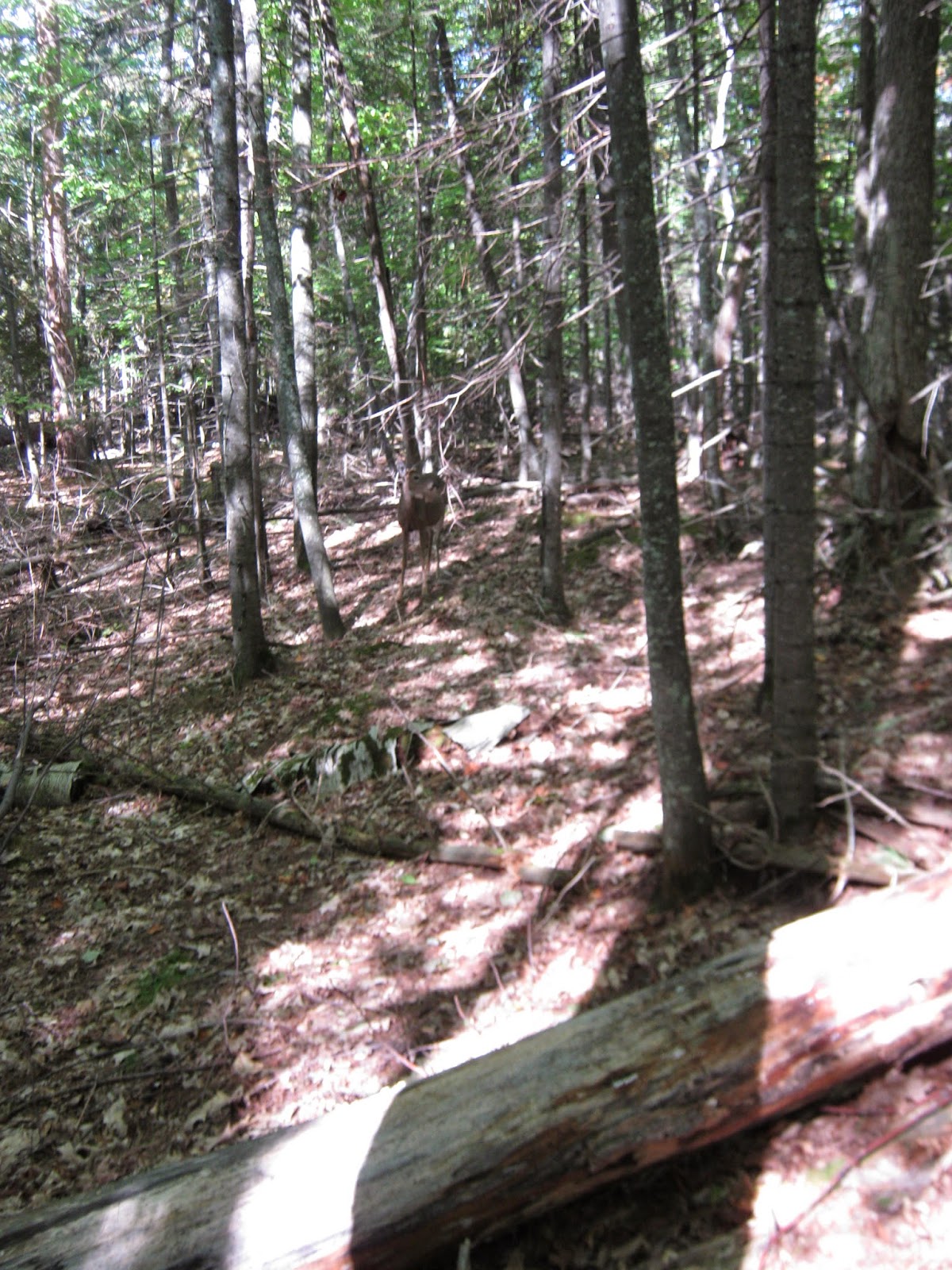
I got within ten feet of this beautiful creature. Her fawn stayed further back. 

A deer provides an excellent example of inter-specific competition. This deer, is more commonly seen than its competitor the moose. The moose and deer both share this habitat and require similar resources. Shelter, food, and water. Water is not scarce anywhere on this island as it is surrounded by the beautiful lake superior, this resource maybe also become a challenge when the lake gets frozen over. Plant life, on the other hand can also get scarce during the winter months. even though the forest is filled with life, and packed with trees, the resources still are fought over, thus the competition.  
(I wish this photo was mine, I've never seen a moose in real life, not even from a distance) photocredit wiki commons

Another thing that the deer can provide us with is an example of parasitism. The deer itself is obviously not a parasite as a deer is an herbivore. No, its not the deer, but its passengers, ticks and fleas. These little buggers, that we try so hard to prevent on us and on our canine friends, can be found all over a hunters favorite animal. Ive even heard stories of massive swarms of these little blood suckers, adding mosquitoes into the bunch, taking down a full size moose. Of course, in this cold northern climate, the winter is a sort of break away from these nasty things, as they cannot survive in the cold.
To continue the journey around presque isle we now look for commensalism. Commensalism is a difficult thing to find, as generally when two items interact both are impacted, but in commensalism, one item benefits and the other is neither harmed nor benefited. I found an example of commensalsim within an old tree stump. A chipmunk or some other small animal had made their home there. The stump was not being harmed or helped, but the chipmunk had a great place to make a shelter. 
notice the small hole at the  base.

The next item that would be commonly found in presque isle is mutualism. Both organisms involved benefit. The relationship I choose I did not see this fall, but saw plenty this summer.  Bees play an essential role in polonating all the flowers that grow in this beautiful park. th bee benfits for their hive, and the flowers get to reproduce. They both benefit from their interactions. Close by on the  bog walk, that our class went on earlier this semester I saw plenty of this interaction. There are whole fields full of beautiful flowers thanks to this mutual interaction
Next on our tour, lets look at intraspecific competition. For this I turn to the trees. Presque isle is full of trees. They pop up everywhere, they grow tall, they fall down, they grow new leaves, they loose the old and their seeds fall as well. Trees compete with one another for resources. Although there is also interspecific competition between various tree species, I still claim intraspecific competition due to the trees all needing the same thing. Like all the baby maples trying to reach above the canopy for the sun. All the oak trees do the same thing. Even from being a seed, like when an acorn is dropped, its a race to see which one will become dinner, and which will become a new tree, though a seed cannot consciously direct where it goes. The trees have to reach their roots down deep for  water, and nutrients in the soil, Trees here are practically growing on top of each other. in constant cycle 


Now that we've seen the trees lets take a closer look. On a great deal of these trees is a micro habitat; lichens. 

This micro habitat found its way up and keeps getting bigger as you can see from the first picture it can be very isolated, or it can be huge, such as the second picture. It is a specific habitat within a larger one. although there are multiple patches of this type of habitat all over the forest, it is still isolated to the tree. It is different from the surrounding area because it is living off of something bigger. it can be easily looked over, but it is everywhere.

Finally lets talk about niches. With so much wildlife, it is hard to choose one niche. so well go with one of my favorite animals, the squirrel.  You see these cute little guys scurrying all over the place. This time of year they are stockpiling their resources for the winter. They live in the trees, they eat the nuts that fall down from their branches, they interact with the chipmunks competing for the same resources, and they are so darn cute. 
Life on preqsue isle would not be possible without th biogeochemical cycles that take palce there. The water cycle happens with evaporation from the lake, and precipitation to get it back down distributed and used for growth. The carbon cycle also happens for providing nutrients to all the vegetation on the isle. Photosynthesis and repsiration occur everywhere with the massive amounts of plant life. Another cycle is the nitrogen cycle, also important to plant life. These cycle are present everywhere and are necessary for the continuing of life. without the cycles nothing could live very long. 
Presque isle is a beautiful place, full of diverse forms of life. Every time you go there its different. take the chance to get there and see something special.

Tuesday, September 30, 2014

Predator Prey Relationships

   Predators-something that is hard to think about. A lot of people think they are just monsters, bloodthirsty. I certainly would not want to get in the way of a predator when it is on the hunt, but predator-prey relations are just natural. If you try to screw them up nature will seriously alter. Some example that were presented in the film we watched were the wolves of Yellowstone and the elk. In a way the elk were predators to the trees. when humans intervened and killed off the wolves, nature was screwed up and the elk population flourished
http://dogshowpoop.blogspot.com/2011/06/montana-marathon-begins.html
    Something that shocked me in the video was the competition between coyote and wolf. Some people might see the wolves killing the coyotes as disgusting and proof of how violent then are. Although, I do find it gross, and mean, I understand the natural need to protect territory so they can survive. Wipe out the competition, similar to what we do as humans, in the job competition world.
http://coyotes-wolves-cougars.blogspot.com/2012/11/u-of-wisconsin-wildlife-professor-tim.html
   
I am happy that we reintroduced the wolves to Yellowstone. I wish that we had not had to do so in the first place. Humans mess everything up! when we reintroduced the wolves, the elk were controlled, and then other life was able to flourish as well. Humans are natures biggest predator, because we cause so much damage. I think it is important to fix the problems we cause, but try not to overdue it because we might screw it up even more such as in Australia with the toads and the rabbits. In Florida the reintroduction of the panther is a scary thought for those who live in the area, but overall they agreed because of the benefit of them hunting the wild pigs. I agree with the idea of trying to protect a species. Even with the reintroduction of panthers, it still causes problems in the human world. we have a highway that cuts right through a big part of their ecosystem. we take over as humans, and do more harm then good. watching the film made me feel despicable as a human, as all we do is destroy, that's why I think reintroduction is important Introducing a new species on the other hand is not okay. Like when in Australia they tried to control pest populations and ended up with an even bigger population overload. Mother Nature knows whats best, don't try to mess with her for our benefit.

    As I stated earlier, I do agree with protecting current species. In the UP the wolves are a symbol. They represent a beautiful thing in nature. Protecting is different than introducing. With the population already low, numbers of their prey would already be higher. I wish it was possible to live in this world without impacting and hurting everything that is around us. The UP is a unique place, where a large amount of nature exists untainted. The wolf is a majestic beast. I feel that there should be more nature preserved than their already is.   http://michiganradio.org/post/illegal-wolf-kills-spiking-michigans-upper-peninsula


Friday, September 12, 2014

Bog Walk

Once again Marquette has proven itself to be a wonderful place to live. The nature here is just so beautiful, and there is always something new and fun out there. I had never been on the bog walk before, while there we enjoyed a lovely day, and learned something new. I love that along the walk there were signs that taught us about the nature of a bog. I have been on bog walks before; my schools have always been very science oriented. It is a great place to go and reflect, and appreciate exactly what is out there.

While at the bog I learned a bit about more. It can be very easy to just walk right past all that was there and not truly appreciate it. There was a variety of plants, water sections, some animals, even a beach at the end. A bog is a unique habitat, that is very diverse, thus creating a great place to study and learn more about the earth. It also just creates a nice place to go and relax outside in general. right off the end the beach was probably my favorite part.  the bog is a unique place where environments meet. the birds sing, the water changes, the plants adapt for the different soil.

Being out there was calming. It was a nice thing to share with my classmates. the favorite plant life of mine was the butter and eggs plant. Orchids and snap dragons are my two favorite flowers, so overall this cute little yellow flower that kept popping put a little sunshine in my day. out of the activities that we had in our packet, my favorite was  making observations without our eyes. We depend them so strongly that sometimes we forget to notice the small things around us; like the feel of bark under your fingers, the wind rushing through your hair,and the ground squishing beneath my feet. It smelt natural. living in the UP we have a special opportunity that other colleges don't have.  Even the smell is wonderful. others would say it is just dirt, and water, but I call it home.There is so much to see, and so much to learn.


Tuesday, September 9, 2014

Whats in that container?


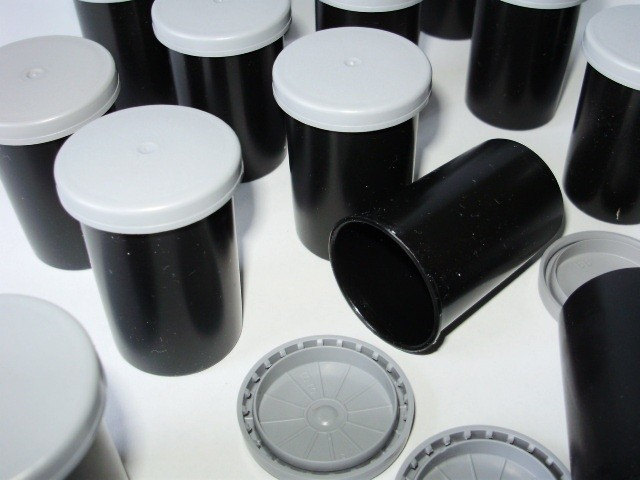
Trying to guess what was inside the film canister was very frustrating. It was really cool to contemplate, and make as many questions about the container as possible. In this activity I learned that there are a great deal of things that can be asked. Questions are the base of how we find out new things. This time we were lucky, that we were able to find out the final answer, what is inside of the container. We talked about how in science sometimes its just not that simple. It can be very frustrating to try to find your results and never really know.
 My group had in the container a white peg and a magnet. We could not figure out why the mass of the test, and the inquired would not match up. We tested using sound, weight, magnetism.  They sounded a little different, they were magnetic, but  we could not get the mass the same, so we added an extra nail, which made our prediction wrong. The original container was still heavier even with the nail added. we found out that the magnets weighed different amounts. This can be applied to any experiment. It shows how important it is to keep variables similar, and to allow a margin of error. Keep testing and retesting.
The emotions I received from longing to know the answer, is how every scientist should feel when researching something. It can be frustrating, having to wait, and retry, not getting instant results, but if it is something you care about you cannot give up. It is very worth it when you do finally receive an answer.
The inquiry wheel can be applied to this experiment because we started  by asking questions. We had to interact and test. We had to communicate with our group members and test various hypothesis about what was inside. we compared evidence,, and tried again and again. it was not a straight line to the answer of what was inside the container. we shook it, we weighed it, we compared the control. if we had used the scientific method we would have had to start all over again when we did not get answers right away; science is not a straight line.

Inquiry Wheel

Science does not happen in a straight line. You can try to define a project, you can have the "perfect plan", but sometimes along the way something can change. For those of us who like to have things mapped out in a nice order, this inquiry wheel is a wonderful alternative to a traditional scientific method. In science things get messy, the questions you intended to ask and find the answer to may change along the way. You may wish for a more thorough response, or find something else you need an answer to. The inquiry wheel allows for this. in the traditional method, you would have to complete things in a straight line, a line that may be difficult to stay on depending on what it is that you are studying. I like the inquiry wheel because it allows more freedom.
 For our project it starts with a question. My group is asking questions about effectiveness of fertilizer, and this question will be the base, just like the scientific method, however with the wheel we have a bit more freedom to move around, to work out what it is exactly we are hypothesizing and finding results. We can experiment and find more information in the process. The wheel works really well, and I'm excited to use it. It may be more difficult to keep track of, but I think that it is a very adaptable method, that everyone should start to use.

For us, visual learners, I have included the pictures of the two methods.

whats alive

Something every kid learns in their elementary science classes is about the definition of life. It was a good review when in our class we talked about our own definitions of life. My group mentioned several of the standard textbook definition such as ability to use or produce energy, ability to grow and change, and ability to reproduce. As a class I enjoyed a few more of the things that were added such as "has cells", even a small thing like that is very important to remember. Defining life was important for our next activity in which we took living things and found out if they really fit the definition.
Doing this activity we definitely took the science is messy literally, as we went out in the dirt to find things that were alive. my group found lots of plants, and grasses, but we also found some bugs. We even ad a little spider colony. This spider colony was fun to watch as they were just teeny tiny, but they still kind of gross me out. The bugs, unfortunately, did not live well in a bag.
From the activity I learned that life has a set definition, but it is also changing. It is fascinating to observe the process of change. after we looked at the bag again a week later, some of the things we thought were dead were indeed alive. Such as the popcorn kernel, or the bean, they had sprouted. one of the coolest looking things was the root that came from a kernel and went through the cotton ball.
Life is always changing, and its a wonderful thing to be a part of. producers consumers, decomposers, they all play a role. one simply has to take the time to watch it. Nature is beautiful  I want to spend more time learning about what happens here on this rock we call planer earth.